Sunday, January 8, 2012

Creepy Crawlers!!!

I'm not a HUGE fan of bugs. But now and then when they catch my eye I slow down and poke at them a bit. I went for a walk on Game Lands 44 today, and though I didn't pick up any bird species it wasn't a waste of time. As I was walking an old service road, I stepped over a fallen tree branch when this caught my eye, whatever this is....

Larvae in the branch of a Red Oak


I have never taken any classes studying insects, so I don't know much about them. And usually when I find things like this I have no idea what they are. Like when we were getting our Christmas tree this year and me and my brother were trimming off branches in my garage when I saw something attatched to one of the branches. I have never seen anything like this before, and being a biology major, I kept it.....other biologists understand..


 Look at his front legs, I think this guy is part crab!


The one day I was outside and noticed something hanging on my garage door, another mystery to me.


Though these creepin' critters don't exactly sit well with me, they have a place in nature and I respect that, now when they are in my house it's a different story. All things in nature have thier place, and some of these guys are very beneficial to us. Such as the carnivorous praying mantis, eating anything that it can get it's goofy hands on. I have read that these eat black flies, mosquitos, and much more, some species even eat frogs, lizzards, and birds! This little guy could be helpful for you gardeners, because they also eat scale insects. The downfall, they eat anything the can get thier goofy hands on....so other beneficial insects are also devoured by this alien like creature. On the contrary, some insects are of course pests, such as the emerald ash borer, a small beattle that our environment agencies spend much time, money, and research on. This beattle bores into our ash trees, and of course kills them. Though they are smaller than a penny, this green slender beatle has swept across alot of ground, leaving behind millions of dead trees. Though they are not my favorite member of the animal kingdom, insects can be interesting!

Field Guides: A Woodsman's best friend...?

When I leave for an outing, some things I simply cannot leave behind. Pencils, field notebook, binoculars, camera bag, and maybe hiking boots and a daypack with lunch and some water if it's going to be a trek. Of all things, my Peterson Field Guide has got to be at the top of the list. Sometimes even when you have the correct I.D. of a bird, it can be helpful to have a field guide with you so you can compare the bird with similar species. This is one thing that the creators of Peterson Field Guides are great at, pointing out the key identification features of a species. Of all pocket guides, Peterson is by far my favorite.
Latest version of Peterson's Birds of Eastern and Central North America

A plate of warblers from the guide, arrows pointing out key field marks.


I have recently been using Field Guide applications with my iPod touch, which I find extremely useful. It is great to have so many different guides in your pocket, and they are all packed with information. I usually use iBird Pro: Interactive Field Guide to the Birds of North America byMitch Waite Group, or Audubon Birds: A Field Guide to North American Birds by Green Mountain Digital. I really enjoy these apps because they have GREAT photography, usually of each species and different sex and age plumages as well as breeding and nonbreeding plumages, which I find more helpful in identification than illustrations. Another great feature that both apps have is the vocals of species. I preffer Audubon's sound library with birds from different populations, which have different accents, because a golden-crowned kinglet from New York sounds significantly different than a golden-crowned kinglet from California. Another reason I spend more time on Audubon's app is because they have incorporated eBird into thier app. EBird is a website where anyone can join, and submit thier sightings as often as they would like. EBird then makes county, state, country, ABA and non ABA lists with your findings and much more. You can also explore other user's bird sightings and data, and see where the sightings were on maps, and it's free to join! So if you like birding, and make species lists, head over to eBird where your findings will contribute to ornithological knowledge!
 http://ebird.org/content/ebird/
With the technology of eBird, I can open my Audubon app and as long as I have wifi tap on find birds with eBird, select a location, then I can choose to search for birds nearby, locate a bird, find notable and rare birds, or find a hotspot with observations surrounding my desired location. Which I think is really cool.

Another book I accumulated was when my girlfriend and I were Christmas shopping in Greensburg and ran into a Barne's and Noble. As soon as I spotted it, I knew that it would be added to my shelf. Bird: The Definitive Visual Guide from the Audubon Society is PACKED with hundreds of species from around the globe. I only cost me around 30 bucks I believe, and has some really great information. 512 pages of range maps, awesome photography, and some info on many common species around the world, this was a good buy. Not all common species that I encounter are in this book because it covers so much area, but I think it's great to come home and read some text about some of the birds that I have shot that day.


A couple pages ducks in North America from "Bird"

Tuesday, January 3, 2012

first birds of 2012!!!

My good friend from the U.S. Army was home over the holidays, and on New Years' Day he and I had to run some errands in DuBois. On the way home I decided to drive past the Tannery Dam and through Gameland Road. While passing the Tannery, I noticed a flock of European Starlings flying over, and an Accipiter land in a tree by the church. I quickly pulled in behind the church and circled around to try and get some looks at the raptor. After doing the best I could to get close, snap a few photos, and confirm a positive I.D. on the bird, I concluded that it was an immature Cooper's Hawk. It was hard to tell because the bird was between us and the sunset, so it was more of a silhouette, and the photos did not turn out as good as they could have if the sun was right.

Immature Cooper's Hawk

Immature Cooper's Hawk

Immature Cooper's Hawk
this was about the point when the bird had enough of my ugly blue truck and flew off


Also at the Tannery Dam were mallards and canada geese, both in good numbers.


Today on my way home from work, I again travelled past the Tannery Dam and over Gameland Road just to see if anything would flush from the roadside to add to my empty year list. While pulling out of work I noticed many American Crows flying overhead, as well as on Gameland Road. There was a single Mourning Dove perched on the electric wires by the church by the Tannery Dam. That's 6 for my year list, and Clearfield county list for 2012. I then detoured around Daniel's Road and flushed 4 Dark Eyed "Slate Colored" Juncos and a single White-breasted Nuthatch, adding 2 species to my Elk county list, with a total of 8 to my year list. Nothing to brag about, but I haven't had time to go birding yet and have two lists at least started.

White-breasted Nuthatch

Sunday I have off and plan on hiking Game Lands 44 in Brockway, hopefully adding a good number of species to my year list, which at the moment is more like a year post-it.....


Monday, January 2, 2012

12/11-12/31

It has been a VERY busy December, and I haven't done nearly enough birding as I had hoped that I would during break. The few times that I have been out was on the way to work or Christmas shopping and took a dirt road to get there hoping that something would catch my eye. One of these times was after work were I took a detour to the DuBois Reservoir and then Kyle Lake on the way home. At the Reservoir I didn't pick up any new species, there was some ice cover and no waterfowl present. Just some canada geese, mallards, and mixed diving ducks. Among the divers were these hooded mergansers that were close enough to offer some not-so-terrible photos.

Hooded Mergansers at the DuBois Reservoir males on either side of bottom centered female Bufflehead female top centered

On the way home from the reservoir I swung by Kyle lake. I didn't see any waterbirds, but I did spend some time watching a female Hairy woodpecker in search of food.

Female Hairy woodpecker
a male will have a red patch on the back of his head, and a downy woodpecker will have black spots on the outer tail feathers

Female Hairy woodpecker

Female Hairy woodpecker

Female Hairy woodpecker scratching an itch

On 12/27, there was a good amount of rain coming down, so I hoped that this would put down some migrating waterfowl. I went to the DuBois Reservoir after work, and as it turns out, I was wrong again. I saw some mallards, american crows, canada geese, and some mixed divers. The immature snow goose that has been hanging around between the Tannery Dam and reservoir was present, and I got this shot of a flushing female hooded merganser.

Female hooded merganser


On 12/29, I ran to the DuBois Reservoir after work to see if I could come across any waterfowl photos, hoping that there would be free water with staging waterfowl closer to shore. There was a good raft of diving ducks in the center of the reservoir, and I got this shot of a female Bufflehead. She wasn't cooperative at all. As I approached her trying to keep large trees between us for cover, she would come out on either side searching for me, and once I got within 30 yards she seemed very timid, so I snapped a picture and let her be.

Bufflehead female

2011 was my first year actually counting and listing my observations. My list isn't as long as I would like it to be, I hadn't even broken 100 species. But, I observed all different kinds of animals and birds in the field, met some really cool people, and even took a few photos that didn't turn out too horrible. Hopefully 2012 has a few more species to offer, a few more hundred would be pretty cool, but I'll take what I can get. As long as I'm out, I won't complain. 


Monday, December 12, 2011

12/8-12/11

On thursday, december 8th, I was getting a bite to eat in between classes, and while leaving campus drove by the tannery dam in case something worth stopping was there. Right away, a spotted a cackling goose among a very large number of canada geese. The cackling goose is formerly included in the canada goose family. This new species is smaller with a rounder head and shorter neck and bill. there are four subspecies of cackling geese, "leucopareia" and "hutchinsii" have a white band around the base of thier necks, the smaller "minima" and "taverneri" lack this white band. (iBird mobile app for ipod)  When I spotted the cackling goose, I pulled into a parking spot and grabbed my camera. When I turned my camera on, a message saying "no sd card" popped up on the monitor... I checked the sd card bay, and saw that the sd card was there, so I pulled it out, plugged it back in, and tried again. The message appeared on the monitor a second time. I removed the sd card from my camera to find that sometime between uplaoding pictures from my last post, and putting the card back into my camera, the card had split in half on one side... This card has over 1200 photos on it, so I was upset to say the least, and of course I didn't have a backup card with me. I left the tannery dam, forgetting about my stomach and headed for staples to get three new sd cards. (That's a lesson learned!!!!) When I got back to the tannery dam a half hour later, thankfully the goose was still there. Here are a few of the photos that I got of the cackling goose.

 Cackling goose among canada geese

Cackling goose among canada geese
(note smaller body size, shorter bill and neck, and smaller rounder head compared to that of a canada goose)

 Cackling goose preening among canada geese

Cackling goose preening among canada geese

Cackling goose among canada geese


I went back to the tannery a day later between class and work to see if the goose was still there, and got a few more photos of the bird. Here is one of the photos of the cackling goose, and a photo of canada geese preening and resting at the tannery dam.

cackling goose and canada geese

canada geese resting and preening


This past October I happened to see two cackling geese at the tannery, and was able to get some photos of them. The two cackling geese that I photographed last October are shown below, the subspecies "minima" and the larger subspecies "taverneri" are shown.

two subspecies of cackling geese, centered "taverneri" on the left, "minima" on the right among canada geese


On Saturday the 10th, I went for a walk around my property in Brockport, and heard the familiar "eng eng" or "yank yank" nasal call of a nuthatch. Thankfully I was wearing camoflauge and could get up close to the two birds foraging in the grapevines. I believe that I have reached my goal of getting a "good" photo of a nuthatch before the end of winter!

white-breasted nuthatch

white-breasted nuthatch

white-breasted nuthatch

white-breasted nuthatch
(note the enlongated back toe, helping the bird cling to the sides of trees while upside down)

Yesterday, Sunday the 11th, afterwork I decided to run to the DuBois Reservoir to spend some time looking for waterfowl. Not so much luck, a few canda geese, ring-necked ducks, and mallards. The water is starting to freeze over and I believe the days of watching waterfowl and waterbirds are running out for the year. But, I suppose that just leaves some time for chasing winter resident birds!

ice on the DuBois Reservoir

ice on the DuBois Reservoir


Tuesday, December 6, 2011

December 2-6

I haven't been doing any serious birding for a while now. Usually when I go out, it's only for an hour or so, not really long enough to bother making a list. But I usually have my camera, so I do take something away from the short-term outings. Friday I had about an hour and a half between class and work so I decided to run to the Tannery dam, where there were many canada geese and mallards. I thought that it would be cool if I could get a photo of a banded goose, and post it. Canada geese are banded regularly, so it didn't take long before I found my subject.

Canada goose with leg band

The left leg is usually banded, each band has a unique number. These leg bands help biologists track migration, monitor survival rates and so on.

I then headed for the DuBois Reservoir to check on the waterfowl species. While there, I saw the usual ring-necked ducks, hooded mergansers, mallards, canada geese, etc. There was a family of tundra swans, 2 adults and 5 first winter were present. I managed to get a few photos showing differences between the first winter and adults, as well as comparing sizes between tundra swans and canada geese.

 Adult tundra swan and first winter tundra swans
note color difference in bills, plumage, and the immature lacks the adults yellow spot on the base of the bill
 in this photo, size of canada geese and tundra swans can be compared

Tundra swans and canada geese

After a brief photo shoot with the swans, I noticed a belted kingfisher perched in a tree. This is another species that I can never seem to be able to get a good shot of.

Belted kingfisher male
a female will have a rusty orange band under the blue band across the breast


Yesterday I didn't have much time for birding, but I ran to the wetlands along platt road to see if I could come across a raptor that was perched in a tree the other day, but didn't allow me to get a positive i.d. No luck with the raptor, though I ran into a flock of black-capped chickadees, white-breasted nuthatches, a few hairy woodpeckers, blue jays, american crows, a red-bellied woodpecker, and 2 red-tailed hawks. I also heard the call of a pileated woodpecker, but could not get a visual or i.d. I spent a few minutes snapping photos of the nuthatches, none of which turned out great. They are a neat little bird if you ask me. In the winter months when food isn't readily available, these little guys hoard nuts and seeds in the cracks and crevaces of tree bark. With thicker shelled nuts, they drill them while in these cracks to get to the nut, or "hatch" the nut or seed. And so came the common name, "nuthatch". They build nesting holes in dead wood. Here are a few of the not-so-good photos of the white-breasted nuthatch. (I WILL get a good nuthatch photo by the end of winter!)
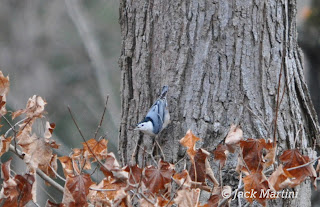
 White-breasted nuthatch with acorn

 hoarding food

 White-breasted nuthatch

Today, I went to the DuBois Reservoir between classes thinking that maybe the rain would bring in some waterfowl and make for some good photo opportunities. I have been wrong before, so I wasn't shocked when I had found that I was wrong today. A few mallards, ring-necked ducks, tundra swans and canda geese were hanging around feeding. So I went to the Anderson Creek end of the reservoir in hopes of catching a few song birds in the brush. I parked and got out of my truck, after waiting a minute I began hearing a familiar "zeet" call, I began scanning the trees and bushes. I saw movement, a pinkish buff colored breast, a yellow terminal tail band, I lifted my nikon and crouched into the brush. I had 3 cedar waxwings right on top of me. This is one of my favorite songbirds, just because of its coloration. This bird has bright red spots on the ends of its' secondary wingfeathers resembling drops of sealing wax, hence "waxwing". It also has a bright yellow tipped tail, contrasting to the rest of its overall grayish slate tail and back. The head and breast is a pinkish buff with a very contrasting black face mask, the bottom of which is outlined with a narrow white line, and a slick crest matching the color of its' head. Cedar waxwings eat alot of berries supplemented by insects, and nest high in conifers. Here are a few photos. The birds were very cooperative and let me get within 15 yards without fluttering. There was a time that one of the birds had its' head behind a branch, so I gave a couple chirps and he came a few branches closer to find out what was making the noise. It's a shame that it was getting dark, or the photos would have come out much better. Guess where I'll be tomorrow before work..
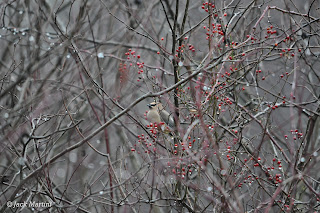
 Cedar Waxwing

 Cedar Waxwing with an American Robin

 Cedar Waxwing
note the red spots at the end of the secondary wing feathers and yellow tipped tail

 Cedar Waxwing
black face mask with narrow white underline, upward crest

 Cedar Waxwing
Everytime my shutter released, he would tilt his head to the side like this

 Cedar Waxwing


Cedar Waxwing

While photographing the waxwings, there was movement in the grass and underbrush, american tree sparrows. Which were hard to get photos of because the brush was so thick. And like most small songbirds, they do not hold still for long...at all. There were 4 or 5 in the group.

American Tree Sparrow

It started to rain a little heavier, and I didn't want to get soaked before histroy class, so I went back to the breast of the reservoir to watch for waterfowl. As soon as I got to the breast, fog started to roll in, knowing I wouldn't have a chance at any visuals on rafting ducks, let alone photos, I headed back to campus. I snapped this photo of Canada geese before leaving.

Canada geese

Being the end of the semester, I am really anticipating winter break to try and pick up a few winter bird species and maybe even a few photos of them as well. Stay tuned for that nuthatch photo....!!


Friday, December 2, 2011

bathing canada geese


I always thought that birds taking baths was cool to watch. Wheather it's a dirt or waterbath, they usually make quite a display about it. Today I was eating lunch at the Tannery Dam and the geese were going crazy. So I took a few photos, and a video.

                                     
Canada geese bathing at the tannery dam


Again, my camera is not designed for videography, so bare with me on this.

Canda geese bathing at the tannery dam


While watching the geese and mallards, there were several american crows searching for food in the grass on the banks of the dam. I had never even attempted to shoot crows with my camera before. They are so easy to spook and not the least bit curious around people in my experience, so I was happy with the shots that I got with this bird, though I only got a few before the bird flew off. No matter, my camera battery died shortly after.


American crow at the tannery dam