Tuesday, September 11, 2012

Bird Banding at The Arboretum at Penn State; Day 1

I haven't been out and about or posted in quite some time. Other than the bird surveys and Canada Goose banding this summer, I haven't really done much feild work or birding. Mainly because of my needed presence at home due to my Mother's battle with cancer, a battle that came to an end August 5, 2012. A week later, I was off to start my new job as a community assistant here at State College and get ready for the new school year. So far, so good! In fact, I was invited into the "Bird World" just recently, and am thrilled to be back!
 
Last week I received an e-mail offering a Bird Bander's Training class here at Penn State, how could I pass that up? We met last Thursday evening in the Forest Resources building to go over a few things regaurding the banding process, why we band birds, do's and dont's of banding, species identification, etc. We were to meet Saturday morning at the Arboretum at Penn State, but the rainy weather forced us to push the banding back a day. Sunday morning I got up at 6:00 AM, packed my clipboard, binoculars, notebook, some water and a quick snack, and my Peterson's, and was on my way to meet the banding crew. I arrived at the Air Quality site at about 6:45. As soon as all the members of the group had arrived, we made our way to the sites and began to set our mist nets.
 
Setting up mist nets first thing in the morning, you already know that it's going to be a good day!
 
 
After all the nets were set, it had taken us about 45 minutes, we decided to check the first two nets for the possibility of there being a few birds. As we arrived at site 1, sure enough there was our first capture of the day, a hatch year Red-eyed Vireo. We then approached the second site to find a male Northern Cardinal.
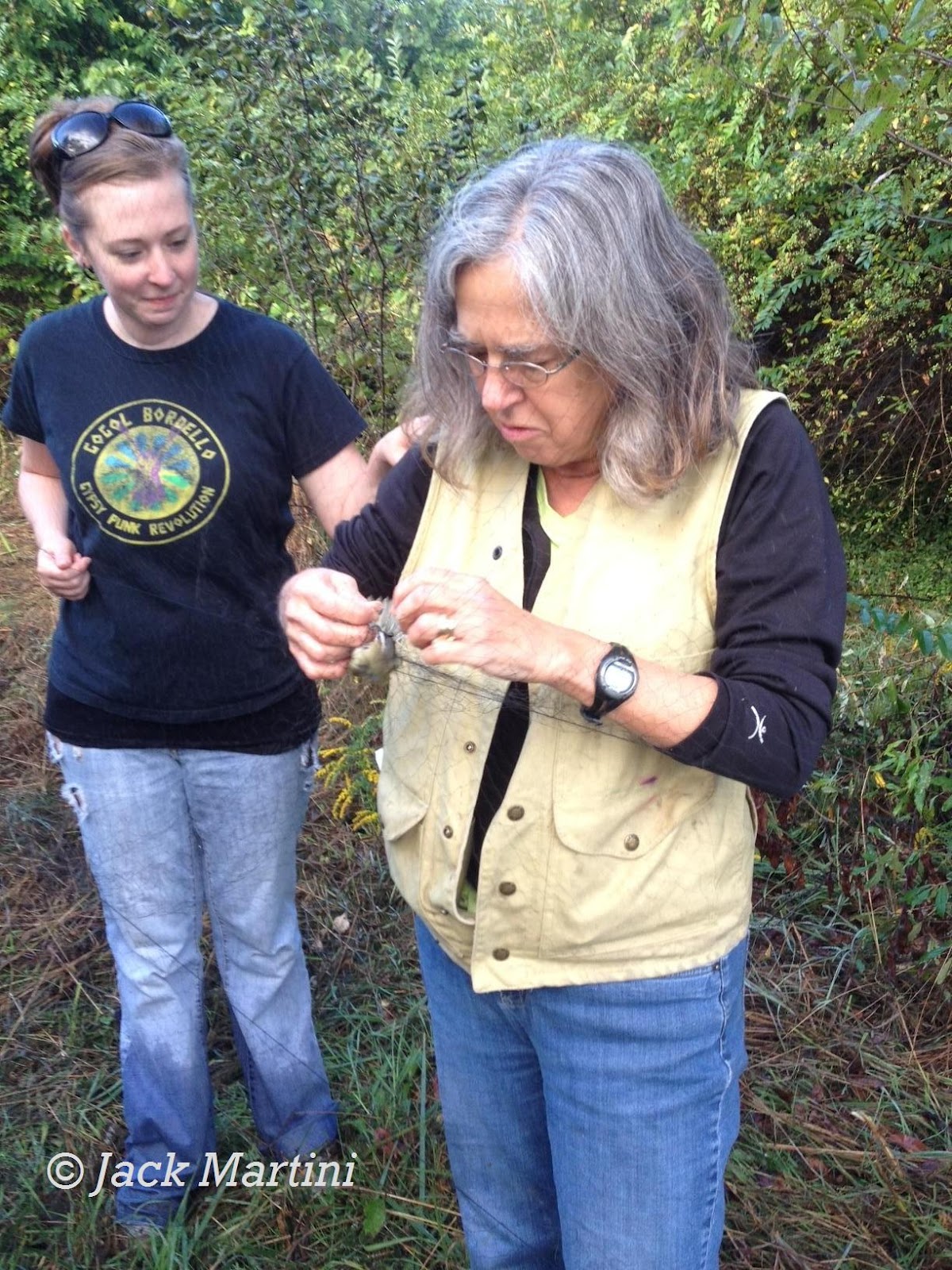
 
Dr. Brittingham recovering our catch from the net.
 
We took the two birds to our banding station for processing, and released them with a new peice of jewelry. While processing, we record the bird's wing chord, tail length, fat content, weight, species, age, sex, and of course, band number. By the time we had processed the two birds, it was time to go check the nets again. This time we brought back quite a few! The highlight of this group of birds was a yellow-bellied flycatcher.
 
A not-so-good shot of a Yellow-bellied Flycatcher.
 
We had some great birds throughout the morning, such as an American Redstart, Mourning, Wilson's, and Canada Warblers, Least, Willow, and 2 more Yellow-bellied Flycatchers!
 
Least Flycatcher

Female Northern Cardinal
 
These were all great birds to have the oppourtunity to handle and get such great looks at. But the best surprise of the morning for me was when I ran into the bander in charge and another student on the trail with ear-to-ear grins. I asked them if they caught something cool, and the smiles got even bigger. They both replied, Sharp-Shinned Hawk....! I enjoy seeing songbirds and I really like seeing waterfowl and water birds,  but anytime I see a bird of prey of ANY species, I am over whelmed with excitement. Unfortunately we could not band the sharpie due to lack of proper band size, but we got some great looks at the bird and I was able to get a quick picture with the star of the show before releasing the raptor.
 
 
Hatch year Sharp-shinned Hawk

Hatch year Sharp-shinned Hawk

Hatch year Sharp-shinned Hawk, you can tell the age of this bird because of the streaking on the face and breast, overall buffy brown coloration, and a yellow eye.
An adult will have a rusty red breast, gray back and head, and a deep red eye.

 
I was extremely happy with the way the first day of banding went. We ended with 33 handled birds. 31 newly banded birds, 1 recapture, and 1 released without a band. There were a total of 16 different species. The recapture was an ovenbird that was originally banded on September 3, 2010. I have 7 more days of banding scheduled this semester, hopefully I can schedule more! 
 
 
Also, I just recieved an e-mail from a waterfowl biologist in Northwestern Pennsylvania stating that it is predicted to be a BIG flight year for waterfowl. He has banded over 400 teal in 2 weeks, tripling any previous year in TOTAL numbers of teal. This is good news assuming that during the spring migration I didn't do as well as I would have liked to with waterfowl and the like. So needless to say, I am really looking forward to this fall's migration!!!
 
Here is a link to an eBird checklist of the birds tallied last Sunday.


Monday, July 9, 2012

Elk Calf Collaring

On June 14th I had the opportunity to assist Eric P., a Penn State graduate who is currently the Elk Biologist Aid for the Pennsylvania Game Commission, collar elk calves with a few other volunteers. How do you pass that up!? The elk in Pennsylvania are actually an introduced species to the area. The native Appalachian Elk are an extinct species, that were over harvested and decimated by early European settlers. Thanks to biologists and conservation efforts, the Rocky Mountain Elk was successfully brought from the western states to Pennsylvania. This new species has established itself very well in our state, are an amazing animal to watch, bring tourists into the area, and can even be harvested if you are picked by lottery.

Eric giving us a quick briefing
Photo by Mrs. R.

I met a former professor Mrs. R. and the other volunteers on the Penn State DuBois campus. We then met Eric and one more volunteer in Penfield, and we were on our way. Eric had been tracking a cow elk for a couple weeks who had been collared before, taking note of where she had been hanging out. That morning, he had a pretty good idea that she had dropped her calf a few days prior, and where she had it based on the locations that he plotted her using radio telemetry (a radio collar sending a unique signal to a radio transmitter). After Eric went over the game plan, we started our trek up through the hills. In about ten minutes, the cow was in sight. She didn't stick around for more than a few seconds before taking off. We went to the spot where she was standing, and began our search. To find an elk calf is tough work! They have a spotted pattern similar to that of a white tailed deer fawn that provides amazing camouflage for hiding from predators, and when they are just a few days old you will almost step on them before they so much as flinch. We spread out in a line and began working the area, searching for any sign of the calf, basically walking in a giant circle scanning the forest floor. After maybe an hour of searching we were headed back towards our starting point, when I thought that I saw something that looked like a calf. I began sprinting towards it, and lost sight. I started to look for tracks when I heard one of the volunteers yell from about 30 yards away, "We got her!" Again, I took off running down over the hill to find Nate M. straddling the calf.

Nate with his catch

Eric had told us that if we happened to find the calf laying down to gently straddle it to keep it from standing up, and try to keep it calm until he could cover the eyes. Covering the eyes of a restrained animal keeps them calm and stress levels low, which is a huge concern for scientists. Once the calf had the sleeve over it's eyes, it calmly laid there and let Eric do his thing.

Our newly collared Rocky Mountain Elk Calf

Eric gathering some data from the calf

After some data is gathered for the calf, location, collar frequency, etc., it is time to give it some ear tags. These have unique numbers on them and are put in place so that you can identify the individual when you come across it. This was the only time that the calf seemed uncomfortable though it doesn't cause any harm or lasting effects, and when Eric put the second one in the calf barely flinched. Eric had told me that they have never had problems with infection or discomfort in ear tags.

Eric about to ear tag our calf


Eric confirming the age, about 4 days, and sex of our female elk calf

Nate and I, just taking notes

After we took the sleeve off of the calf and backed away, she trotted off to meet back up with her mother. This was unfortunately the only calf that we were able to collar that day, though we tried for several more. I spent that day driving around with some good people, glassing and stalking elk for the Pennsylvania Game Commission, can't complain about that!


Wednesday, June 27, 2012

Northern Goshawk Banding

Well, I have'nt posted regularly for a while. Mostly because swing shift limits the time that I can spend outside and I do not have much to post about. Also, it's because when I get off work I dont feel like it!!! BUT, I said that I would post about my Northern Goshawk banding trip and Elk calf collaring adventures, so here we go! I met one of my former professors (Mrs. R.) at Penn State DuBois, and we departed with a small group of volunteers a little after 6:00 pm on Sunday, May 27. We got to our destination in Warren Pennsylvania around 8:00. The U.S. Forest Service provided housing for us that night at the intern house.

The banding crew bumming around at the house. That's me in the camo hat, I'm 95% positive I was sleeping here, I had worked 8-4 that day!
Photo by Mrs. R.

Well, 6:00 am came pretty early, especially when you are spending the night in a sleeping bag on a cement floor! There was a shortage of beds and couches, so being the gentleman that I am, I chose to leave the beds to the ladies. Truth is I could have slept on a bed of cacti that night!! Anyhow, we met Dave B. around 6:30 that morning. Mr. B. is a known scientist/bander, who was leading the gang. We arrived to where we would leave the vehicles, and after a quick briefing began our short yet enjoyable trek through the lush Allegheny National Forest.

Lugging the gear up the trail to our site.
Photo by Mrs. R.

When we arrived to our "staging area", Mr. B. gave us a quick rundown of the process. We would set the net, bait, and build a blind where two of us would sit and wait for the Goshawks to take our bait under the nest, while the rest of the crew waited at a staging area. We wanted the main group to stay far away from the site of the Goshawk nest as not to spook the birds.

The crew, getting our game plan lecture from Mr. B.
Photo by Mrs. R.

 
The crew, getting our game plan lecture from Mr. B.
Photo by Mrs. R.

We left the staging area carrying the gear for the net and equipment to build the blind. Mr. B. had told us that the 3 chicks in the nest were too old in order to capture. They were young enough that they had yet to leave the nest, though old enough to fly short distances. In order to band chicks, you must first capture the adults, then climb the nest tree and gather them.  These chicks were 36-40 days old, and very able to leave the nest if we were to try to climb the nest tree. One of the chicks actually fledged as soon as we got to the site.

Looking at the Northern Goshawk nest and chicks
Photo by Mrs. R.

I was very excited to see the Goshawk chick, acording to the "Peterson Field Guide to Birds of Eastern and Central North America" this is a scarce species, for which I have no recording sightings.

The Northern Goshawk nest with one of the chicks

The Northern Goshawk nest with one of the chicks
Can you beleive that this big guy is only 36-40 days old!?

After letting us get a good look at the visible chick, along with a few photos, Mr. B. put us to work! Another student Toby N. and I were assigned the duty of setting up a pile of logs to put the bait on as well as help clear brush for the drop net, while others built a blind and also cleared brush. Once the brush was cleared, we began setting up the drop net.

Some of the other volunteers and I clearing brush and setting up the drop net.
Photo by Mrs. R.

Now that the net had been set up, and the blind was built, it was time to set the bait. Bait may not be the best word choice, maybe lure or decoy...? How about helper? Anyhow, once we were ready Mr. B. got out our helper, an injured and unreleasable Great Horned Owl. This owl had been on many banding projects, none of which has caused harm to the owl itself or the birds that it was aiding capture to.

Mr. B. with our helper.

The owl is set on the cunstructed log pile below the nest on the opposite side of the drop net. When the parent goshawks see this natural predator they swoop down from the nest to fend him off, resulting in the defending hawk to hit the net and be safely restrained until volunteers capture and process the bird. So what is the point..? Mark and recapture, or capturing animals, fitting them with a unique band or radio transmitter, and recapturing them, is conducted to study the behavior of that species. Using these methods, we can study migration, population growth, population loss, survivorship, breeding habits, population density, and much much more. Some think that this is harmful for the animal, and puts them in distress. Of course the animal is in distress, but as scientists we keep this in mind. And while practicing these management techniques we try to keep stress to a minimum. Simply by covering the eyes of and being as quiet as possible while handling animals, the stress levels can be kept very low.

Mr. B. giving our helper his instructions.


Our helper sitting on his throne, he held strong for the day!
Photo by Mrs. R.

Mr. B. and the banding crew checking the finishing touches to our site.
Photo by Mrs. R.

After setting up our net site and leaving two members of the group behind to sit in the blind, we returned to our staging area around 9:00 am to wait and hope for good news. While most of the group played cards, I was listening to bird songs and thumbing through my field guides.

The banders playing cards
Photo by Mrs. R.

We waited all morning for one of the volunteers in the blind to come over the radio with good news. I was racking up my species lists for the day, county, and even got a few for the year. At one point Mrs. R. said, "Jack, I didn't know that you were a good birder!" How else could I reply other than, "I'm not...!" I had a great morning getting looks at several warbler species, comparing songs for different forest birds, and we even caught a few glimpses of a Red-Shouldered Hawk.

This is where we spent hours and hours waiting for that call on the radio.

Right around noon Mr. B. sent a volunteer down to the blind to deliver lunch and releive one of the volunteers waiting. Nick from Garret County Maryland came back with some great knowledge in bird song identification. We spent the afternoon discussing bird songs, calls, and he and Mr. B. helped me get a handle on a few species as we sat and listened waiting for the radio call. The call never came, but the volunteers at the blind did with rough news. The female had flown without going after our helper, and the male had yet to show up. So the new plan was for all volunteers to wait at the staging area, while Mr. B. waited far enough from the nest to be undetected, while staying close enough to hear the hawk hit the net. Sometimes things don't go the way that you plan or hope, and by 5:30 pm the majority of the group left the woods that day without getting an up close look at a mature Northern Goshawk, unfortunately I was one of them. I was told by one of the volunteers that they had captured the female parent about an hour and a half after we had left. This bird was captured last year, which also took all day to happen. The male had never showed up, we assumed that he had another territory that he was occupying that day. Though I wasn't there for the recapture of the bird, I spent the day with a group of scientists and science students in the beautiful Allegheny National Forest which made for an extremely relaxing and enjoyable Memorial Day.


Friday, June 15, 2012

Pymatuning State Park

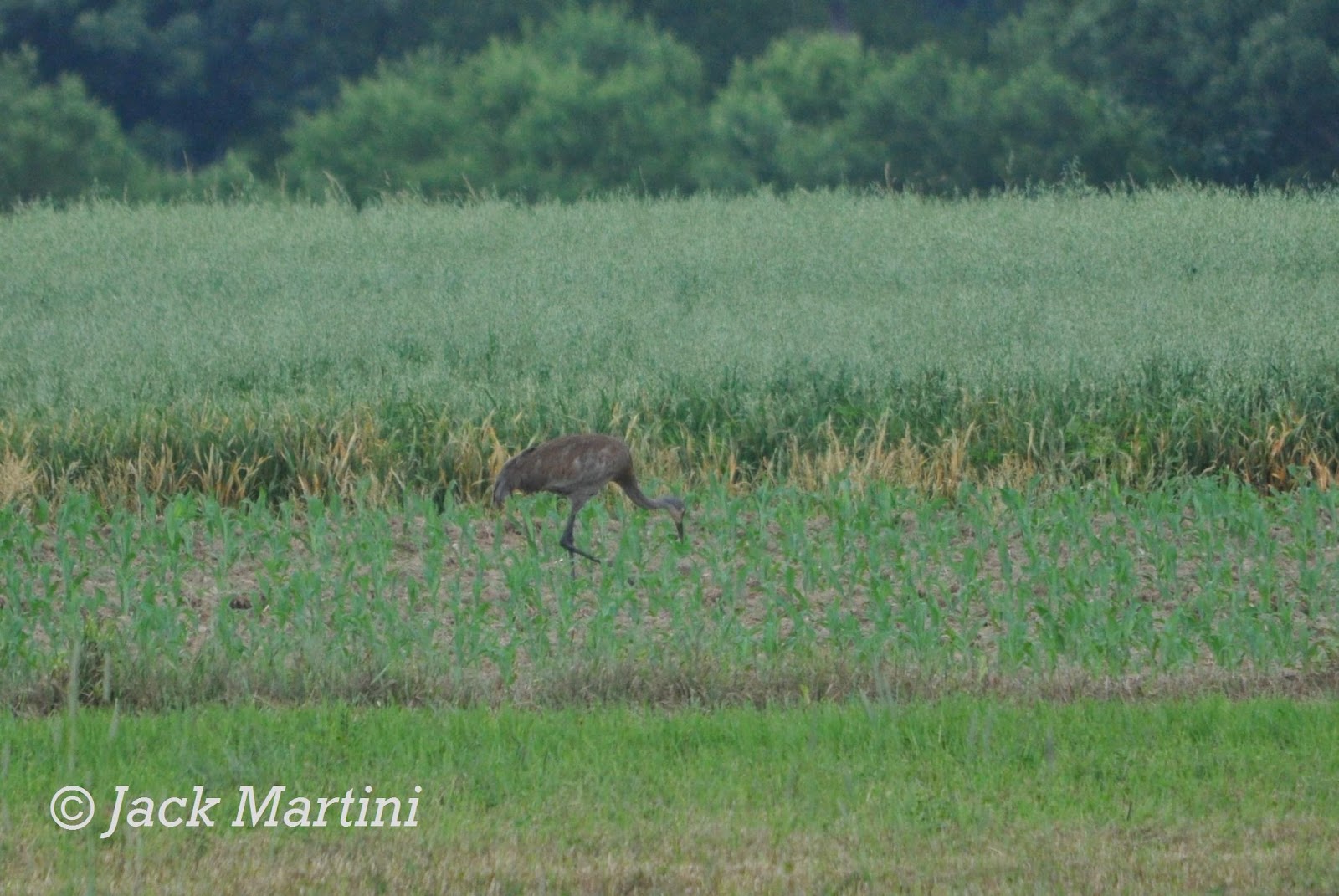
I am very sunburnt and tired, so I am going to appologize if this post is a dull read!!! BUT, I was laid off from my job at the local glass factory this past Monday. I was on the midnight shift, and when I got home at 8 in the morning, I decided that I was going to pack up and leave town. My dad has been at our camp near Pymatuning State Park the past week, so why not join him for some fishing/birding while I have some time off right? I packed up my gear and left town around 1:00 pm. It was 3:00 pm when I was coming into Linesville, the town on Pymatuning Reservoir where our camp is located. I was scanning the corn fields on either side of the road where large numbers of Canada Geese can be seen, hoping to pick something up cool like a snow or cackling goose that got off track during migration, and never left. It was cloudy and drizzling, so visibility was not at an all time high. I happened to glance to my right and see two large birds, now keep in mind I had been up for 21 hours by this time, just drove for 2, and was feeling goofy. I just assumed that the birds were turkey. But these turkey were a brownish tan......with very long necks and legs and bills....SANDHILL CRANES!!!!!!! Yes I did actually yell that to myself. By this time I had passed the birds, so I pulled off to the side of the road, swan dove into my backseat for my camera bag and bins, pulled a U-Turn on a main highway, and backtracked. Needless to say, I was excited. I had heard sandhills while banding ducks 2 years ago in this location, but never saw them. When I got back to the birds, I pulled off the road, put on my blinkers, killed the engine, lifted the nikon, and fired away. They were about one hundred yards away, and as I said visibility wasn't great, but here are some of the photos that I managed. There were just the two, no chicks, and I watched them forage for about ten minutes.

Sandhill Cranes

Sandhill Cranes

Sandhill Crane

Sandhill Crane


They started to walk away from my jeep, so I figured that I would leave them alone. I pulled away and headed towards camp. While passing the Linesville spillway, I saw a bird that was noticeably different from the rest. At first I thought to myself Greater-White Fronted Goose. So I parked in the spillway parking lot and grabbed my camera bag. As I approached the goose I was stumped, Pink Footed....? So I snapped a few photos and decided that I would figure it out later because I did not want my camera to get rained on too horribly. After examining the photos I believe that this is a feral Greylag Goose.

Feral Greylag Goose

Feral Greylag Goose with Mallard

Canada Goose
Canada Goose
What I thought was a "hutchinsii" race cackling goose, but after studying photos that I have taken of cackling geese and a discussion with a knowledgable birder that I know, this is just another Canada.

A couple buddys feeding the fish.

Common Carp at the Linesville Spillway


When I arrived at camp and showed my dad the photos, he said that there was a big white bird hunting with a Great Blue Heron the day before. He described the bird and it sounded to me like a Great Egret, however the bird was nowhere to be seen that evening or the rest of my time at the park. In early June, the Walleye are really hitting, so while we were on the boat I wasn't doing much birding. We fished Monday evening, Tuesday from 8:30 am until about 5:30 pm, and Wednesday from 5:30 am until about 4:00 pm. We caught quite a few fish, some highlights were catching my limit of Walleye within the first four hours on Tuesday, and my three 12-13" White Crappie that I picked up within 15 minutes of each other on Wednesday! I spotted several Bald Eagles, gulls, terns, osprey, cormorants, loons, and herons while fishing and tons of swallow species. I also got a glimpse of a Great Crested Flycatcher. He didn't offer the best photo opportunities. But as I said, we were taking fishing seriously this trip.

Immature Bald Eagle

Richie, waiting for the sun to come up.

The sunlight hitting the Ohio side of the lake

The sun coming up over Pennsylvania

Richie

Great Crested Flycatcher

Great Crested Flycatcher


When I left Wednesday evening I searched for the Sandhill Cranes again because after I texted Andie Graham about my sightings, she told me that she was making a trip with her boyfriend the next day to do a little birding of their own and I wanted to give her the most up to date location. No luck with the Sandhills, though I did pick up an Eastern Meadowlark, and watched some shorebirds, an immmature Bald Eagle, and a Great Blue Heron drink, forage, and hunt for food in a small pond. An older couple approached in a vehicle and told me that they observed a Semi-palmated Plover and a Curlew at this spot a week prior, and that a pair of Snow Geese had just left the area about a month ago. I would have loved to stay and search for the plover and curlew, but I had to wake up at 5:00 the next morning to go elk calf collaring, I had a 2 hour drive ahead of me, and it was 8:00 pm. I am laid off for a week, so maybe I can make a special trip back to do a little birding!

Families of Canada Geese

Families of Canada Geese


Immature Bald Eagle

Great Blue Heron

Eastern Meadowlark

Eastern Meadowlark


Thursday morning I went elk calf collaring, and it was a good time! I have been waiting for the photos to be sent to me from the Northern Goshawk banding trip, when I get them I will do a double post of the hawk banding and calf collaring, so stay tuned! On the way home from collaring, a raptor caught my eye while it was hunting along the road, causing me to once again pull over and dive into the backseat for my camera. Here are a few photos of the bird, a Broad-Winged Hawk, one of my favorite birds of prey.

Broad-Winged Hawk

Broad-Winged Hawk

Broad-Winged Hawk