Tuesday, November 27, 2012

Thanksgiving Break

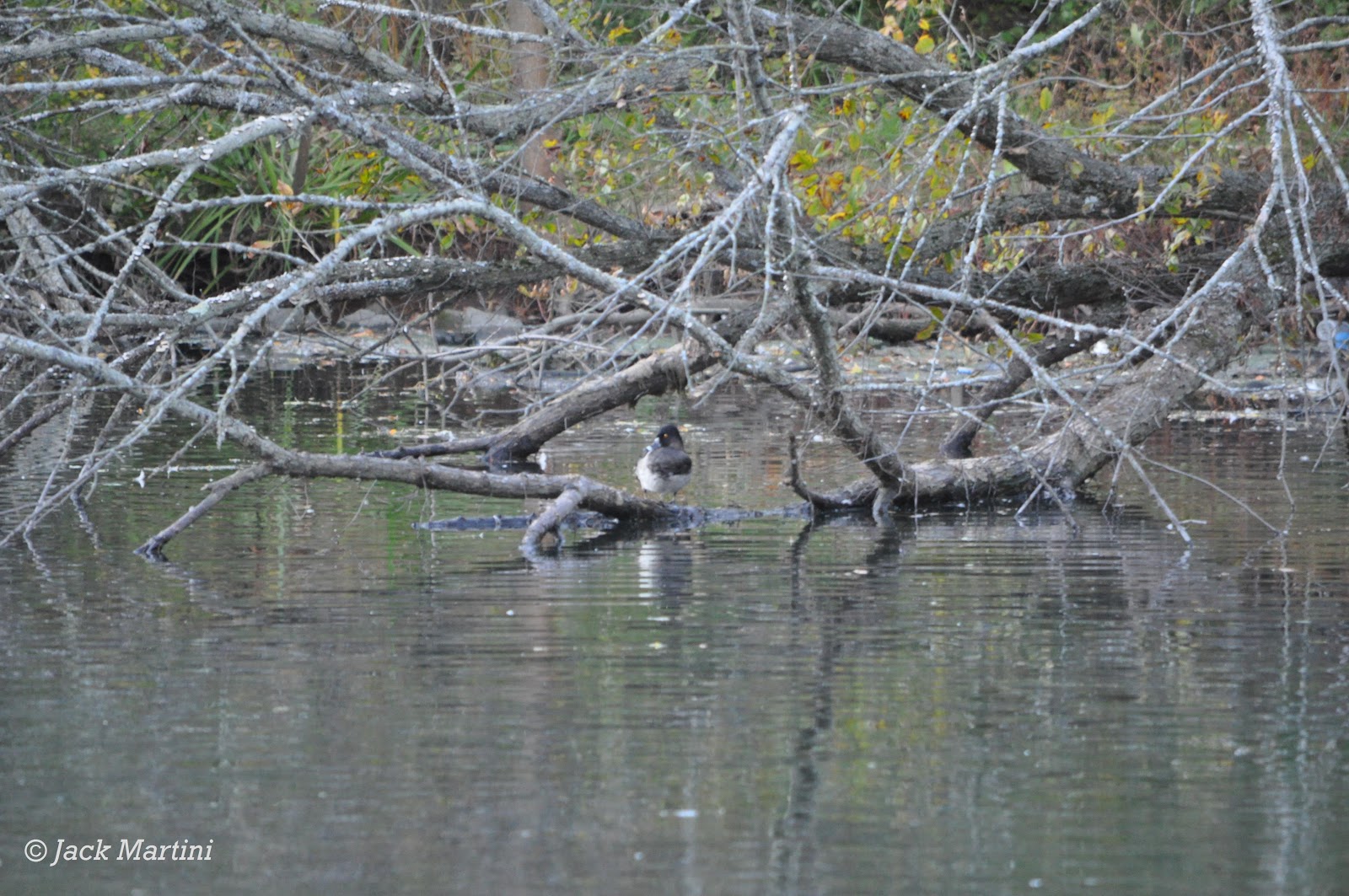
Over my short Thanksgiving break from classes, my girlfriend Brooke and myself did a little bit of what I like to call lazy birding. We were out and about the Sunday afternoon before Thanksgiving, and decided to stop at the local coffee shop and grab a brew. I happened to know the barista that was working, and we happen to be in the same major. We were getting caught up on our bird talk, and she began telling me sightings of ruddy ducks, great egrets, and bald eagles in the area. As you can imagine, the gears were turning as to where would be a good place to make a quick stop and maybe pick up a few ticks from the car, while Brooke's mind was probably gearing towards the American Eagle catalog. As we were leaving the coffee shop, I told Brooke how I'd like to stop at a few of my favorite spots before heading back home. She didn't object, so I took this as a green light and we were on our way to what I thought would be the best place to lazy bird from the car, of course, the DuBois reservoir. As we arrived I saw a lonesome duck on the water, and at first glance said American Black duck. I didn't give the bird too much attention after that, as I was trying to turn ring-necked ducks into scaup, canada geese into cackling or snow geese, and anything flying over into a non-passerine.
 
A good raft of ring-necked ducks, about 125 in this group

Mallards at the reservoir
 
 
Scanning the opposite shore line for anything good, and the middle of the reservoir for maybe a red throated loon, I was getting a little bit discouraged. It took a birder named Mike to park beside us and say black-scoter, and the american black duck dove under water, for me to get a little interested in what was going on. I put the bins on the bird and sure enough, after giving it a serious look, was a female black scoter. Boy did I feel stupid.
 
Female Black Scoter

Female Black Scoter

Female Black Scoter
 
Mike and I discussed the recent sightings in the area, as well as a few exciting experiences of our own. After a few minutes he was on his way, telling me of a spruce stand that was holding good numbers of crossbills that was near the reservoir before taking off. I was familiar with the area, so I had to check it out. After a short drive we arrived at the spruce stand to only find black capped chickadees, ultimately turning the search for the crossbills into a bust. I was happy however with the scoter sighting, and I think that I may be getting Brooke warmed up to this strange "birding" thing.
 
The afternoon of Thanksgiving, Brooke was on her way to work 2-6 at the hospital, and I was on my way to a pine stand on the boarder of Jefferson and Elk counties. I needed to see a crossbill. After spending about an hour in the area, the only thing that caught my interest was this single red-breasted nuthatch. I know birding is typically better in the mornings and evenings rather than afternoon but c'mon....I must really be out of practice..
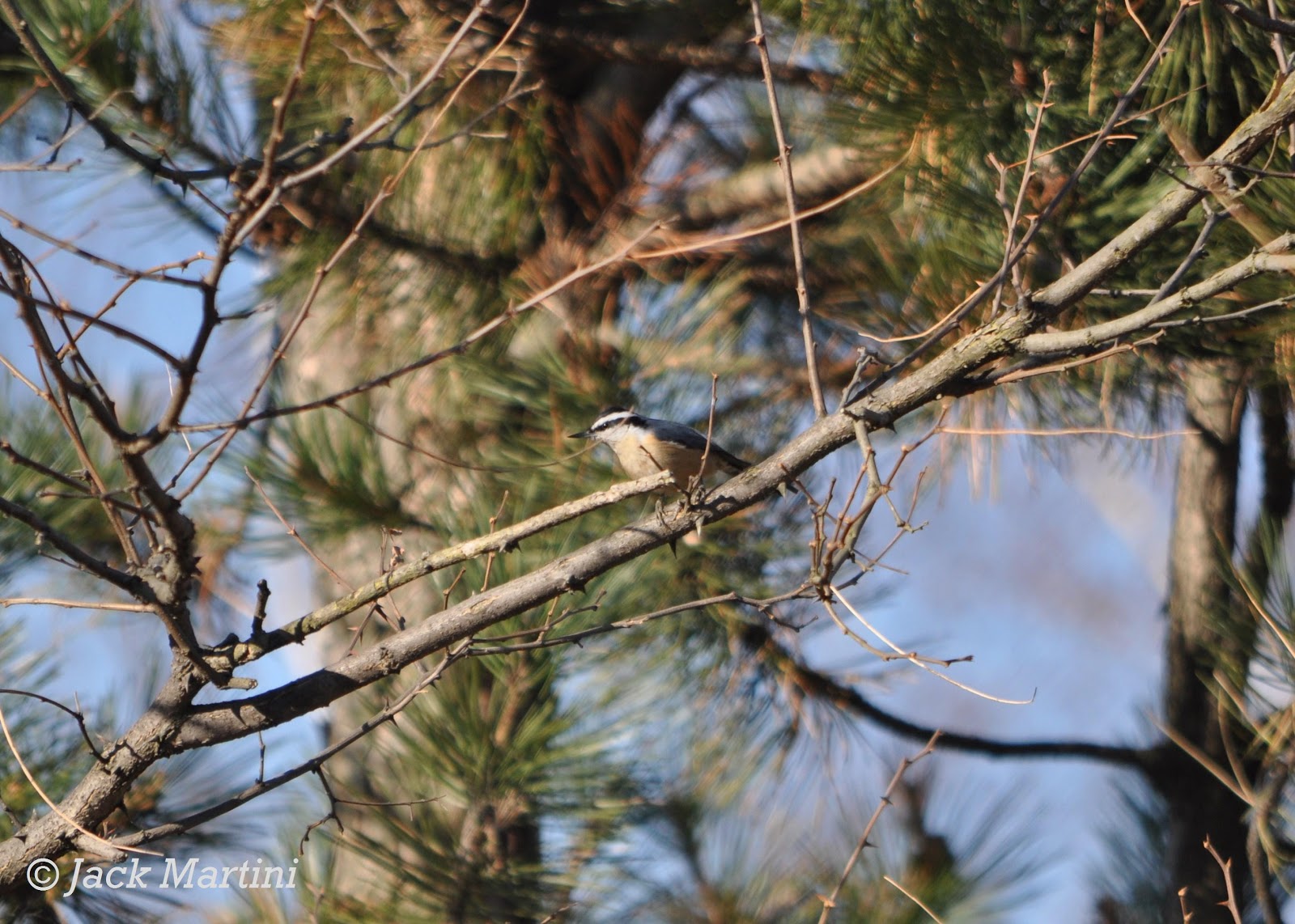
 
Red breasted nuthatch

Red breasted nuthatch
 
I watched the nuthatch pick at the pine cones for a few minutes before it tired of my camera shutter and nuthatch imitations, and flew off.
 
I didn't spend as much time birding last week as I had hoped and planned, but when do we ever? Saturday I will start a new job, freeing up my day time, and allowing me to get back out into the woods! For now, I'm off to get some looks at the Northern Shoveller and Gadwall pairs that were reported yesterday! I hope that everyone's Thanksgiving break was as relaxing, but perhaps a little more productive, than mine was!


Monday, November 26, 2012

Need an asprin....?

Ever wonder how a woodpecker builds a cavity for nesting..?
Check out this video clip of a Pileated Woodpecker making a new home!
 Notice how it is using it's tail feathers to help stabilize itself on the tree.
You would think that these things' brains would rattle loose!!
Skip about half way through to get to the good stuff.


Sunday, November 25, 2012

RECAP

Greetings birders and bloggers from all corners! I hope this post finds you, or you find this post rather, in good health, high spirits, and long plentiful checklists!
As for myself, I have REALLY let myself down this fall as far as birding. I haven't done any serious birding in months!!! 
Last October, a ring-necked duck was being reported at a local water body here in state college, and reporting it as a rare. I had my girlfriend staying for a few days, and we had some time to kill, so I thought that we could go try and get some looks at this bird. As soon as we got there we were greeted with numerous mallards and a pair of canada geese, swimming quickly towards the bank, climbing up onto the grass, and coming within a couple of feet from us hoping for a free handout. I thought that this was a great opportunity to get some great mallard close ups.
 
Male and Female Mallards
 
Female close up
 
Female close up
 
Male close up
 
After spending some time with the mallards, I remembered what we had come in search of, and started to scan the water surface and nooks and crannies in the shore line for the diver. All alone on the opposite side of the pond, hanging out in a snag, was the star of the show, a drake ring-necked duck.
 
Male ring-necked duck
 
It was starting to get late, and I had the feeling that my companion for the evening was getting bored, so we headed for GIANT to get things to cook dinner. I thought that it was a good  "birding ice-breaker" for my girlfriend, maybe she won't mind coming with me more often...?
 
About a week after the search for the ring-necked duck, I was looking for a continuing group of green winged teal and a northern shoveler. After walking and searching for the water body that they had been reported on for about a half hour, I finally found it. I began walking down into the valley where the retaining pond was. Flushing several song sparrows and red-winged black birds from the thick thistle weeds and brush along the way.
 
Song Sparrow
 
As I got closer to the water, the red-winged blackbirds were NOT having it, and started aggressively calling and flying over.
 
A not-so-happy male red-winged blackbird
 
These RWBB were making me nervous. I knew that the ducks, if they were even still there, knew that something was wrong, that these squawking birds were not making a production for the sake of practicing for a Broadway musical. I got as low to the ground as possible, crawling on all fours with my camera bag on my back when necessary. I heard movement in the water, I could see ripples on water's surface. I crept around the edges of the cat tails, listening to the chatter of nervous ducks just ten feet away on the other side of the thick vegetation. I stopped where the cat tails parted, and gave me a clear view of the water. Just then, four green wing teal came around the spit of grasses. Spotting me, they exploded into the air, wings and water making quiet a racket. I snapped this one shot as they lifted off.
 
Green wing teal exploding into flight
 
Knowing that these birds had been here for several days, I grabbed the nearest cover that I could find and waited for them to come back. In doing so, the female northern shoveler nervously flushed from the cat tails. I dug in and waited, and sure enough after about a minute they all came back.
 
Green wing teal coming in for a landing

Female northern shoveler coming back to rest
 
These birds all landed in the same place that they took off, the other side of the vegetation that I could not get looks at. I hung out there for a few minutes, listening to their grunts and skwauks of a conversation. There were seven teal and one shoveler in total, one teal revealed herself for a brief moment and allowed me to get the bins on her, and snap a quick photo.
 
Female green winged teal
 
I had a low flyover while I was sneaking out of the area, one that I am not quiet used to being from a one stop light town!


Sunday, November 4, 2012

Again, Why Birds.....?

It has been WAY too long since my last post, or trip outside with my nikon in general.....
BUT, to make up for lost time, and followers, I will post a link to a video sent to me by one of my former professors a couple of years ago. I have it saved in a folder in my webmail.....because it's awesome..and this is one of the many reasons that make birds, especially raptors, awesome...ENJOY!!

Wednesday, October 3, 2012

Jo Hay Vista / Jackson Trail

This past Saturday, September 29, I chose not to follow my plans in going to Hawk Mountain Sanctuary in Kempton, PA. So instead, I went to Jo Hay Vista and enjoyed the scenery for a little while.
 
The view of State College, Pennsylvania
 
I hung out at Jo Hay Vista for about half an hour not seeing or hearing too much other than Blue Jays, Red-Tailed Hawks, and American Crows. So I decided to check out the Jackson Trail. Waiting to greet me at the trail head was this juvenile Yellow-Rumped "Myrtle" Warbler foraging on the ground and in the underbrush.
 
Juvenile Yellow-Rumped "Myrtle" Warbler

Juvenile Yellow-Rumped "Myrtle" Warbler
 
This bird let me crawl up within ten yards and watch as it picked through the grass and foliage at insects and larvae.
 
Just up the trail from the Yellow-Rumped Warbler, an Eastern Phoebe caught my attention as it crossed in front of me and perched in a low-hanging branch of a sapling.
 
Eastern Phoebe
 
This bird also let me get close and allowed me to watch as it chased after flying insects.
 
I continued my walk up the trail when calls caught my attention to my left. I not-so-gracefully fumbled through some thick saplings and came upon a group of about 15 more Yellow-Rumped Warblers foraging in the canopy and understory.
 
Female Yellow-Rumped "Myrtle" Warbler
 
I watched this group of warblers for a few minutes until they moved on, and then so did I. I walked for about a half mile up the trail without hearing or seeing anything other than alarm calls of Chipmunks as they would scurry across the forest floor and under a rotted stump, or the buzzing and chirps of insects. So I turned around, and headed back. On the way back to my Jeep, I spotted the Eastern Phoebe where I last saw it, along with a handful of Black-Capped Chickadees following a group of about fifteen Black-Throated Green Warblers. The warblers were high in the saplings, and stayed concealed by the foliage. One particular bird did come down from the group and perched, allowing me to get great looks and a few shots.
 
Female Black-Throated Green Warbler
 
Thursday I am banding at the Arboretum at Penn State before classes. Be sure to visit Birding Pennsylvania again soon to see how I make out!!


Tuesday, October 2, 2012

Bird Banding at the Arboretum; Day two

 September 20, was my second day banding songbirds at the Arboretum at Penn State. Though I didn't get to spend much time banding before class, two hours total, I got to get some looks at a couple good birds. It took a while for me to finish this post, I had to download some software from the web so I could upload the pictures from my new camera!!
 
Here is a checklist of the birds captured on the 20th.
 
New Banded

T.Titmouse - 3
Gray Catbird - 14
Brown Thrasher - 1
Magnolia W. - 2
Ovenbird - 1  
N. Cardinal - 1
E. Towhee - 2
Song Sp. - 2
Purple Finch - 3
House Finch - 1

Recaptures

T. Titmouse - banded 9/9/12
Gray Catbird - banded 9/13/12
E. Towhee - banded 4/25/12
 
And a link to the checklist for the birds that I tallied and captured for my short two hours.


Watching the sunrise waiting for the rest of the group to arrive.


First catch of the day, An adult male Eastern Towhee.
One of my favorite forest birds!

 
Traveling with the male, a female Eastern Towhee was caught in the net within six inches of the male.


Here is a close up of the male EATO, I love how dramatic the contrast between blood red and flat black is in this bird.
 
My Aunt Susie lives in Pittsburgh, Pennsylvania, and is always telling me about how the deer and turkeys are in her yard. She sent me a picture of a hawk that was posing for her in her back yard on morning.
 
 
Even in the city you can enjoy the beauty of wildlife and nature, such as this Red-Tailed Hawk.


Tuesday, September 11, 2012

Bird Banding at The Arboretum at Penn State; Day 1

I haven't been out and about or posted in quite some time. Other than the bird surveys and Canada Goose banding this summer, I haven't really done much feild work or birding. Mainly because of my needed presence at home due to my Mother's battle with cancer, a battle that came to an end August 5, 2012. A week later, I was off to start my new job as a community assistant here at State College and get ready for the new school year. So far, so good! In fact, I was invited into the "Bird World" just recently, and am thrilled to be back!
 
Last week I received an e-mail offering a Bird Bander's Training class here at Penn State, how could I pass that up? We met last Thursday evening in the Forest Resources building to go over a few things regaurding the banding process, why we band birds, do's and dont's of banding, species identification, etc. We were to meet Saturday morning at the Arboretum at Penn State, but the rainy weather forced us to push the banding back a day. Sunday morning I got up at 6:00 AM, packed my clipboard, binoculars, notebook, some water and a quick snack, and my Peterson's, and was on my way to meet the banding crew. I arrived at the Air Quality site at about 6:45. As soon as all the members of the group had arrived, we made our way to the sites and began to set our mist nets.
 
Setting up mist nets first thing in the morning, you already know that it's going to be a good day!
 
 
After all the nets were set, it had taken us about 45 minutes, we decided to check the first two nets for the possibility of there being a few birds. As we arrived at site 1, sure enough there was our first capture of the day, a hatch year Red-eyed Vireo. We then approached the second site to find a male Northern Cardinal.
 
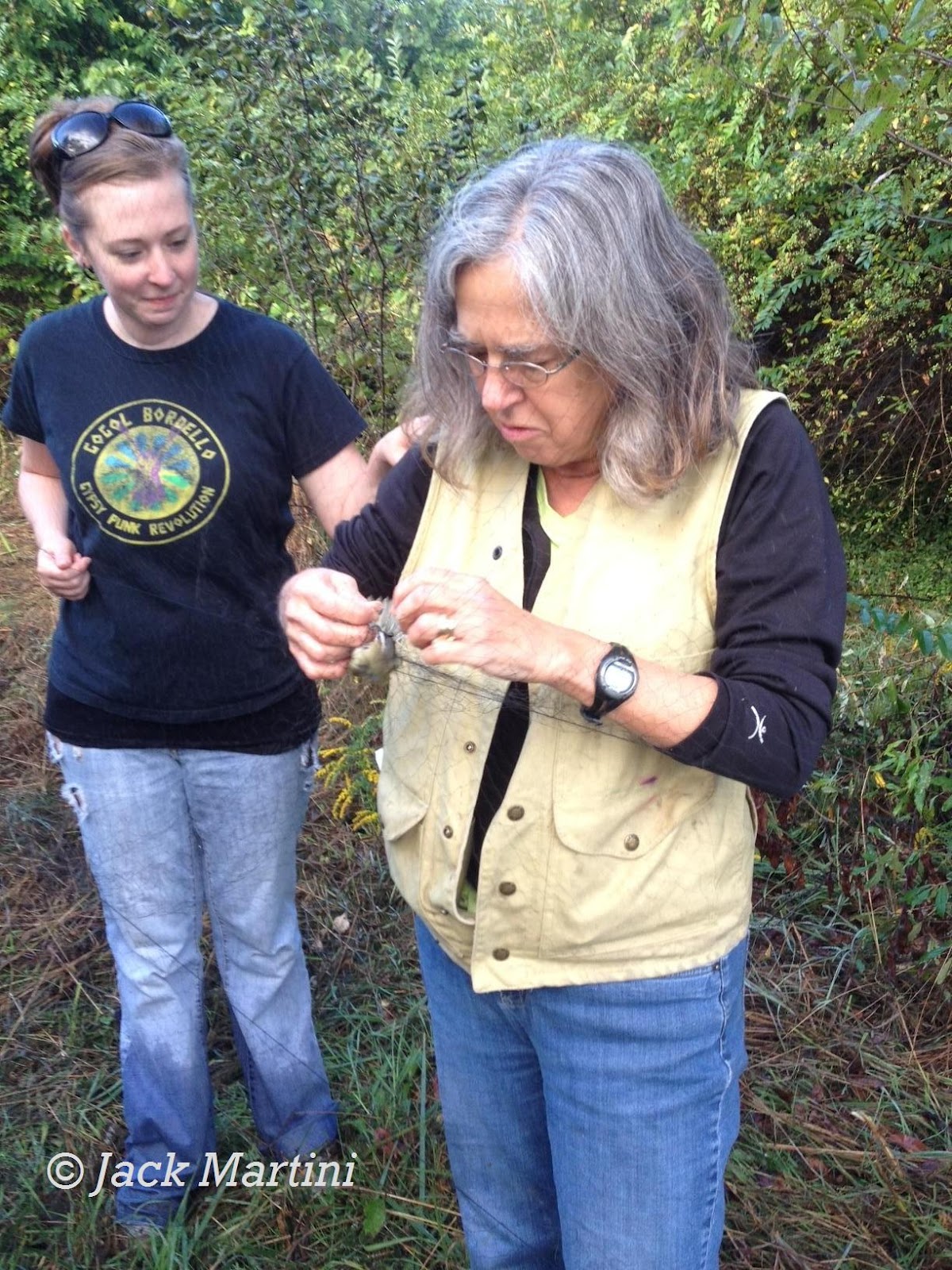
Dr. Brittingham recovering our catch from the net.
 
We took the two birds to our banding station for processing, and released them with a new peice of jewelry. While processing, we record the bird's wing chord, tail length, fat content, weight, species, age, sex, and of course, band number. By the time we had processed the two birds, it was time to go check the nets again. This time we brought back quite a few! The highlight of this group of birds was a yellow-bellied flycatcher.
 
A not-so-good shot of a Yellow-bellied Flycatcher.
 
We had some great birds throughout the morning, such as an American Redstart, Mourning, Wilson's, and Canada Warblers, Least, Willow, and 2 more Yellow-bellied Flycatchers!
 
Least Flycatcher

Female Northern Cardinal
 
These were all great birds to have the oppourtunity to handle and get such great looks at. But the best surprise of the morning for me was when I ran into the bander in charge and another student on the trail with ear-to-ear grins. I asked them if they caught something cool, and the smiles got even bigger. They both replied, Sharp-Shinned Hawk....! I enjoy seeing songbirds and I really like seeing waterfowl and water birds,  but anytime I see a bird of prey of ANY species, I am over whelmed with excitement. Unfortunately we could not band the sharpie due to lack of proper band size, but we got some great looks at the bird and I was able to get a quick picture with the star of the show before releasing the raptor.
 
 
Hatch year Sharp-shinned Hawk

Hatch year Sharp-shinned Hawk

Hatch year Sharp-shinned Hawk, you can tell the age of this bird because of the streaking on the face and breast, overall buffy brown coloration, and a yellow eye.
An adult will have a rusty red breast, gray back and head, and a deep red eye.

 
I was extremely happy with the way the first day of banding went. We ended with 33 handled birds. 31 newly banded birds, 1 recapture, and 1 released without a band. There were a total of 16 different species. The recapture was an ovenbird that was originally banded on September 3, 2010. I have 7 more days of banding scheduled this semester, hopefully I can schedule more! 
 
 
Also, I just recieved an e-mail from a waterfowl biologist in Northwestern Pennsylvania stating that it is predicted to be a BIG flight year for waterfowl. He has banded over 400 teal in 2 weeks, tripling any previous year in TOTAL numbers of teal. This is good news assuming that during the spring migration I didn't do as well as I would have liked to with waterfowl and the like. So needless to say, I am really looking forward to this fall's migration!!!
 
Here is a link to an eBird checklist of the birds tallied last Sunday.